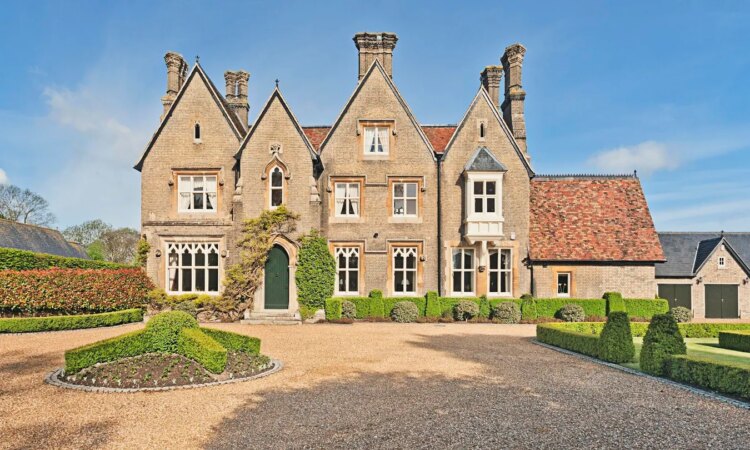

Even well-funded buyers are struggling to find luxury homes as more high-end properties sell off-market. Here’s what’s driving the shift and how buyers gain access.
getty
If you’re shopping for a luxury home and coming up empty-handed, despite a healthy budget, you’re not alone. Many high-end buyers are discovering that the homes they want simply aren’t listed publicly anymore. This can be incredibly frustrating.
That’s because in today’s luxury real estate market, a growing share of properties are being sold off-market, meaning they never appear on the MLS, don’t have traditional marketing, and skip open houses entirely. The result? Even well-funded and cash buyers can struggle to find inventory that meets their criteria.
“This is a major shift from a decade ago,” says Ricky Carruth, Chief Housing Analyst at RLTYco.
And even when luxury homes do hit the MLS, the listings look different than they used to. This means including fewer photos, lighter descriptions, and less details about the property’s most notable features.
While this may seem counterintuitive, the move toward discretion has quietly become one of the most influential trends in luxury real estate.
The Quiet Rise Of Off-Market Luxury Homes
Although off-market listings may feel new to many buyers, they’ve long existed at the highest levels of the market, particularly in New York City.
“It’s been part of the NYC luxury market for decades, especially among ultra-high-net-worth sellers,” notes Mike Fabbri, a luxury real estate broker with The Agency. “What’s changed over the last few years is how common and intentional it has become, driven by increased visibility online, social media exposure, and a greater focus on privacy and control.”
The shift accelerated dramatically during the pandemic. As longtime city dwellers decided to leave urban centers, like New York, demand surged, without a corresponding increase in supply.
“In my market, the off-market trend really took hold around Covid,” Libby McKinney Tritschler of William Raveis tells me. “There was a massive influx of buyers coming out of New York City and simply not enough inventory to meet demand. During that time, agents had to be proactive—door knocking, calling past clients, and reaching out to neighbors—to uncover potential sellers.”
So, what began as a necessity in 2020 ultimately became a preference in 2026.
When Social Media Exposure Becomes A Liability
While social media has transformed real estate marketing, it has also introduced new risks—especially for high-profile and ultra-wealthy sellers.
“Sellers don’t want their home treated like content or a backdrop for curiosity,” explains Fabbri. “Off-market allows sellers to control who sees the property, how it’s presented, and when information is shared. For many high-net-worth sellers, the goal isn’t visibility; it’s control.”
Once photos are online, they’re effectively permanent. This has made sellers increasingly cautious of posting every little detail of their home online, especially for high-net-worth individuals and public figures.
“Once something is online, you don’t get it back. Sellers are increasingly cautious about detailed photography living online indefinitely,” Fabbri explains. “Many prefer to limit photos or reserve full details for vetted buyers only. I once had a photographer digitally remove a highly identifiable, valuable artwork from a listing photo.”
As a result, many listings now withhold floor plans, detailed layouts, security systems, safes, valuable collections, and even certain outdoor spaces until a buyer is fully vetted.
In some markets, safety concerns are even more explicit. “One agent I know in Beverly Hills won’t photograph wine cellars, safes, or security systems anymore—sellers demanded it after a $2 million jewelry theft where the thieves clearly knew the layout,” says Carruth.
Privacy, Not Security—Is Often The Real Driver
In other markets, privacy outweighs security concerns altogether. Ivan Chorney of the Ivan + Mike Team at Compass shares that this is increasingly true in Miami.
“As Miami has become more globally affluent and more visible, demand for private transactions has increased significantly over the past three to five years,” notes the broker. “Privacy is the primary driver. Many owners do not want neighbors, staff, or the general public knowing their business.”
Sellers are also pushing back against how homes are publicly evaluated.
“Another issue is the growing frustration with mass portals and automated pricing tools that often misrepresent value,” Chorney adds. “Sellers are increasingly resistant to having their homes defined by algorithms or public speculation.”
When Sellers Don’t Need To Sell
Another reason off-market listings are flourishing: many luxury sellers don’t actually need to sell.
“Often, ultra-luxury properties may only be available off-market because a seller will only consider an extremely compelling offer,” Lisa Simonsen, a broker with Brown Harris Stevens tells me. “Other sellers want to test the market, or they erroneously believe that they can get a higher price by selling off market, which isn’t the case for a standard two-bed condo or a tract house in a subdivision.”
Off-market homes are often rare, architecturally distinctive, and priced well above the local average. With no urgency to sell, owners retain leverage.
“The lack of urgency means they operate from a position of leverage,” Chorney explains. “Ultimately, it comes down to scarcity. If the product is truly unique, demand will surface regardless of how firm the seller may be.”
How Buyers Gain Access To Off-Market Homes
For buyers, access to off-market properties comes down to relationships and responsiveness. Off-market homes aren’t listed on a secret database. They require brokers to tap into personal networks, call colleagues, and quietly match buyers with sellers.
“If you want your broker to leverage their relationships and reputation to find you something off-market, you need to establish yourself as the kind of client worth risking that capital for,” reveals Carruth.
This isn’t something that agents and brokers do for the average buyer. “Off-market deals happen because of relationships, not listings,” he says. “Your broker is going to call colleagues, reach out to past clients, and tap their network. That takes time and social capital.”
Carruth also emphasizes speed and communication. “If your broker brings you an off-market opportunity, respond within 24 hours. Even if it’s ‘not quite right,’ explain why and refine the criteria.”
“The fastest way to kill off-market deal flow is to be non-responsive or indecisive,” he adds. “Agents talk—if you burn one broker by wasting their time on off-market deals, good luck getting another to work that hard for you.”
Why Off-Market Still Isn’t Right For Everyone
Despite its growing popularity, selling off-market isn’t always the best move.
“Off-market sales absolutely have their place,” states Tritschler. “If I have a buyer who clearly fits a property and a seller values discretion, I will always explore that path.”
Still, she cautions against assuming privacy always outweighs exposure. “I firmly believe we are still in a market where exposure matters. The more eyes on a home, the more opportunity for strong offers and leverage.”
For many sellers, certainty remains the goal. “Most sellers ultimately want certainty—and that’s still best achieved by letting the market speak.”