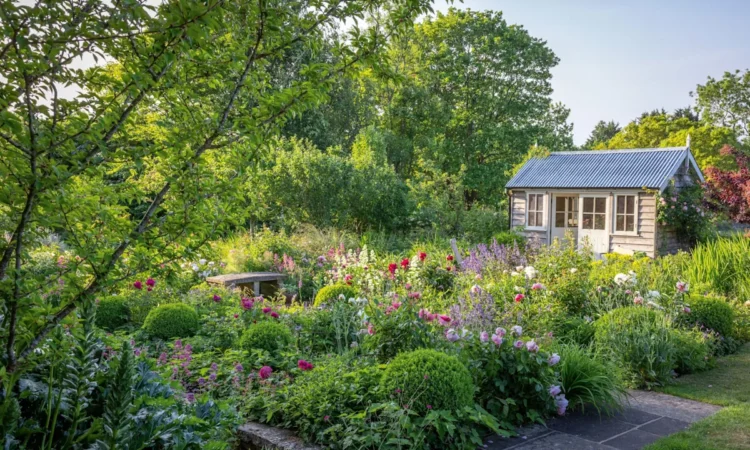
Last June, the photographer Jonathan Buckley came to shoot my garden at Spring Cottage for a new book by Clare Foggett, Beauty & Abundance. It was a dreamy summer’s day, the peonies and roses at their peak, but it was a very different picture 20 years ago. The journey began on a starlit frosty night in November 2005, when my husband drove me 20 miles west towards the village of Cold Aston, right on top of the Cotswold plateau. He had bought Spring Cottage at auction that evening, without telling me. It was the fait accompli to end all faits accomplis, and completely out of character.
The auctioneer had introduced the run-down cottage by saying, “This one has location, location, location,” and he was spot on. The south-facing third-of-an-acre garden, bounded by low stone walls, has long-reaching views across small fields grazed by sheep, and it’s down a quiet no-through lane. As I stood in the garden, on that chilly November night, the stars of Orion the Hunter seemed close enough to touch, because it’s a big-sky garden. It’s also cold here, and not just on a November night. I once had a thank-you letter from a garden visitor addressed to Val Bourne, Almost Spring Cottage, Cold Cold Aston.

Bourne in her south-facing garden – Jonathan Buckley
The auctioneer had failed to mention the dilapidated shed containing a cocktail of chemicals, many of them banned decades ago. As a lifelong organic gardener, I had to face the reality that the soil contained chemical traces, whether I liked it or not. The dearth of earthworms was balanced out by a glut of cutworms, and they proved to be a jackdaw attraction. Weeds were rife: ground elder and bindweed crept under the lichen-stained walls and still do, although they are tackled every spring. Dandelions and sorrel seeds blow in from the fields, because the south-westerlies are savage here. Bindweed and field bindweed still trouble certain areas, and as an organic gardener I cannot use glyphosate, so everything has to be removed by hand. On the plus side, we have deep, dark soil and get light throughout the day because of our open position.
The garden slopes gently down to the lane, where a spring gurgles its way down to the Windrush. Certain areas, where celandine and willowherb spring up, must have spring water deep underground. Most of the garden doesn’t have a water table, however, because we’re over 700ft above sea level. My soil has no clay content, so it fails to hold moisture and nutrients, and I’m continually top-dressing with leaf mould and burying garden compost. I’ve taken to using seaweed meal, a polymer that swells up rather like wallpaper paste, in an attempt to beef up the soil.
I’m a self-confessed plantaholic, and I overplant. I tell myself (and my husband) that it’s deliberate, because I want to cover the ground to lock in carbon, conserve moisture and encourage ground beetles, among other insects. Ground beetles are the biggest devourers of slugs and slug eggs, and organic gardeners rely on the natural world, not on slug bait.
Organic gardeners also aim to provide a supply of flowers for much of the year, to sustain pollinators, and my garden is like a living library; it is intentionally diverse, so it contains trees, shrubs and many types of plants. I have four main areas here: a spring border, a summer border, an autumn border and a productive garden. I’d advise all gardeners to segregate their plants seasonally for two reasons: it makes maintenance far easier, and it looks better. You’ll never get a fading peony near an aster, for instance.

Bourne aims to provide a supply of flowers for much of the year – Jonathan Buckley
Within days of arriving here, I was planting up hastily dug-up hellebores and snowdrops at the lower end of the garden. They flowered the following spring, and they looked truly awful. It taught me that trees and shrubs are vital visually, because they add perspective. They are protective, too. The overhead canopy, even if devoid of leaves, keeps the worst of the weather off, and the roots help drain the ground. The following year I added flowering cherries, including ‘Kursar’ and ‘Okame’, and there are now 14 witch hazels and a dozen early-flowering daphnes. These woody plants provide winter scent, and their presence allows me to succeed with hardy ferns, snowdrops, erythroniums and trilliums.

The garden is intentionally diverse, with trees, shrubs and many types of plants – Jonathan Buckley
Roses and peonies major in the summer borders. Both tolerate our cold winters, and they complement the long low stone cottage, now fully renovated. When I arrived, I wanted to plant historic roses with fancy names like ‘Louise Odier’ and ‘Souvenir de la Malmaison’, but I had trouble choosing them. Many were too tall and arching, and others suffered from disease, particularly black spot. This is unsightly and debilitating, because the leaves drop off, thereby weakening the rose. I knew I had to opt for bombproof and healthy roses because organic gardeners can’t use fungicide.
The three really healthy repeat-flowering roses I rely on are ‘Champagne Moment’ (Korvanaber), raised by Kordes of Germany, and two David Austin roses named ‘Wildeve’ (Ausbonny) and ‘The Lark Ascending’ (Ausursula). ‘Champagne Moment’ is a lightly scented buff apricot-white floribunda and quite possibly the best rose I’ve ever grown. ‘Wildeve’ is a light-pink quartered rose, and ‘The Lark Ascending’ has a sunset mixture of yellow and warm pink, and it’s hardly ever out of flower. Pastel-tinted roses blend well together, and their petals absorb less heat from strong summer sunshine. Darker roses frazzle in hot summers, so I avoid them because we get the sun all day long.

Bourne says she tends to overplant: ‘I tell myself (and my husband) that it’s deliberate’ – Jonathan Buckley
I’ve gone for Chinese peonies. They flower just before the roses, and some will still be in flower at the end of June. These are the only plants staked here, with semicircular iron stakes. Their handsome glossy foliage blends in with the young rose foliage. Many of mine are French-bred fragrant doubles raised in the mid-19th century, principally for the cut flower market. The bomb-shaped silver-pink ‘Mon Jules Elie’, the lemon-scented cream ‘Duchesse de Nemours’ and the magenta-flecked ivory-white ‘Festiva Maxima’ all flower well. The double peonies and roses offer nothing for pollinators, so these borders also contain nectar-rich penstemons, paler astrantias, valerian, Nepeta ‘Chettle Blue’ and Campanula lactiflora ‘Prichard’s Variety’.

Nectar-rich Nepeta ‘Chettle Blue’ is a pollinator-friendly addition to the garden – Jonathan Buckley
I also grow lots of roses that flower only once in June, because these are the ones that drip with flower in midsummer. They flop over the low stone walls and include the creamy-white rambler ‘Astra Desmond’, the apricot ‘Goldfinch’ and a thorny buff-white American noisette named ‘Gardenia’.
Most organic gardeners grow vegetables and fruit, and there are raspberries, blackberries, strawberries, blackcurrants and redcurrants to eat in summer. Our three apple trees and our apricot keep us supplied in top fruit, and there are 12 different tomatoes in the greenhouse. In summer there are peas to pick, lettuces to cut and plenty of cucumber sandwiches. The winter vegetables sustain us in bleak weather, and we grow brassicas and store winter squashes, onions and shallots.

Bourne’s productive garden provides plenty to eat in the summer months – Jonathan Buckley
I am keen on longer grass; after all, it’s another opportunity for a plant-mad gardener. In spring there are native daffodils on the verges, and the mini-meadows in the garden also begin early. We can’t grow snake’s-head fritillaries here, but we do succeed with the golden-belled Fritillaria pyrenaica, and it mingles with cowslips, camassias, pasqueflowers and Anemone pavonina. In summer, hardy orchids and wild flowers keep the butterflies happy, and we’ve recorded 24 species here. The bees and insects are just as important as the flowers – and all part of the satisfaction. Bringing a garden back to life has been a great joy.
Val Bourne’s garden is featured in Beauty & Abundance by Clare Foggett (Quadrille, £35), which will be published on April 16; photography by Jonathan Buckley