Aston Villa’s ‘wingers’ have polarising roles.
The right-winger usually holds width and stretches an opponent’s back line. The left-winger is ostensibly a left-sided ‘No 10’ (attacking midfielder) drifting into central areas and creating midfield overloads. Width is provided by the left-back, stationed in high and wide positions.

When Villa move the ball slowly and the left No 10 and left-back are already standing in their fixed positions, opponents can nullify their threat. When Villa play with tempo and the left No 10’s movement inside triggers the left-back’s run — for example, the full-back overlapping as the left No 10 simultaneously runs inside — it is harder to deal with.
In the first 13 minutes against West Ham United, Villa performed the same choreographed rotation pattern three times. With centre-back Pau Torres restored to the side, Villa had their most proficient passer in deep areas to supply the move.
The first attempt came in the second minute. West Ham’s right-back, Aaron Wan-Bissaka, was instructed to follow Morgan Rogers, even if it meant leaving his position to track the 23-year-old centrally.
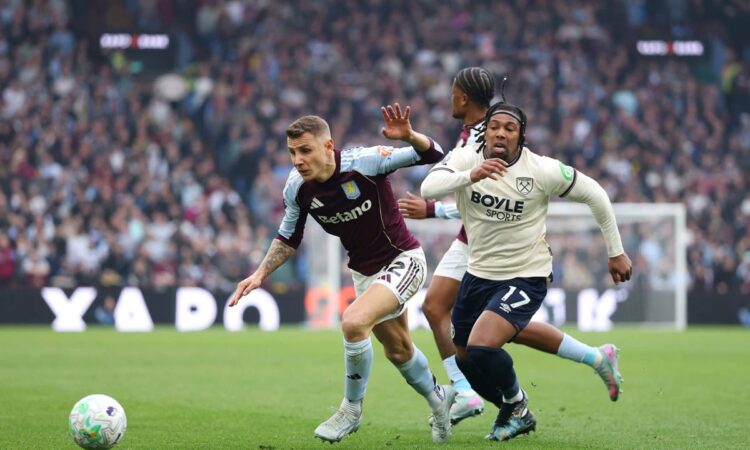
If Lucas Digne, Vila’s left-back, ran past Rogers too early, West Ham would have been able to set themselves. However, Digne recognised the trigger, moving at the perfect time and knowing Rogers was occupying Wan-Bissaka.
Here, Torres receives the ball, prompting Rogers to offer a passing option to feet. This vacates the space at right-back, with Digne beginning his overlap. His marker, Jarrod Bowen, is too high and square on.

Torres chips the ball over Wan-Bissaka and into Digne’s path, but his pass is overhit and Konstantinos Mavropanos intercepts.

Nine minutes later, Villa try again.

Wan-Bissaka’s preoccupation with Rogers continued to leave a huge hole in the right of West Ham’s defence, giving Digne or Ollie Watkins space to spin into that channel.
Villa’s average positioning showed that Rogers stayed just as central but higher than Watkins. As a sidenote, notice how the dark, thick shade of green shows the regularity of passes from Torres to Digne.

Villa’s left-sided schemes may have been less successful had West Ham stuck with their original plan. Nuno Espirito Santo named a back three, but Jean-Clair Todibo’s calf injury in the warm-up scuppered the blueprint. A wing-back system has commonly stifled Villa, crowding their centralised attack.
Todibo limping off meant Nuno opted for midfielder Freddie Potts to replace him, either an obvious error in hindsight or an indication of how little faith he has in Max Kilman, his alternative centre-back option on the bench.
Villa were emboldened to persevere and two minutes later, Torres picked out Digne’s run again.

The France international’s pull-back cross towards either Jadon Sancho or John McGinn was cut out, yet Villa kept the ball in West Ham’s territory, with Mateus Fernandes fouling Rogers.

The free kick was shrewd, with Villa identifying West Ham’s tendency to drop deep from wide set plays and vacate the edge of the box. Villa played two passes around the area, ending with McGinn’s whipped effort into the bottom far corner.

The repeated left-sided patterns reflected Villa’s broader performance. Villa’s faster tempo brought a sharper edge — movements and rotations were crisp and performed with intensity, replacing their recent static patterns.
McGinn’s goal was his 11th Premier League strike from outside the box, with only Ashley Young scoring more for Villa. His return from injury has raised the intensity of Villa’s attacking movements.
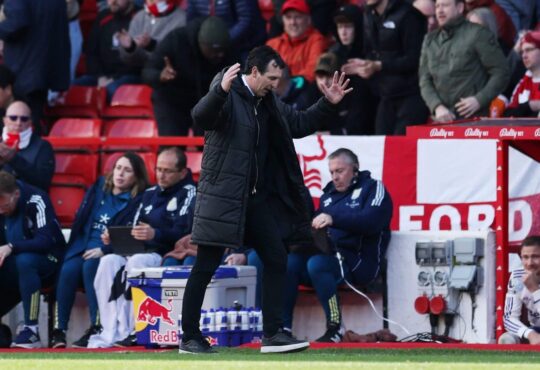
As Unai Emery explained afterwards, McGinn and Rogers’ versatility helps make Villa unpredictable. The pair had switched positions from Thursday night’s win against Lille, with McGinn then operating from the left, Rogers as the archetypal No 10 and Ian Maatsen at left-back.

“Morgan is a versatile player as well,” explained Emery. “Sometimes he achieves his good performance inside (the pitch) and outside. He played a fantastic game today. He can even play on the right side and he performs fantastic there. His mentality is the most important. If he keeps it and I speak to him about being in different positions, he does not refuse.”
With Rogers shifting left here, Emery could toy with Wan-Bissaka. Ross Barkley began to take up positions at left-back, outside of West Ham’s out-of-possession block. This gave Digne the licence to make persistent forward runs and for Rogers to drag Wan-Bissaka inside the pitch.

Forty-five per cent of Villa’s attacks in the first half came down the left, compared to just 25 per cent from the right. Sancho occasionally drifted across, wanting to take advantage of the space.
In the 21st minute, Rogers took Wan-Bissaka inside as Digne continued his run. Watkins received the ball, turning and fed the left-back, whose return pass was narrowly cut out.

Before West Ham’s visit, Villa had scored the fewest goals of any Premier League side in 2026 (10). On Sunday, Villa created 17 chances to West Ham’s six. Rediscovering incision with patterns of play, practised on the training ground, performed quicker, pulled apart a West Ham shape that surely carried regrets of changing from their initial three-centre-back shape.
Villa were blistering at times in the 2-0 victory and, having missed two Opta-defined ‘big chances’ in the first half, perhaps should have blown West Ham away sooner.
Nuno made two changes at the break, hoping to push his team further upfield and not so vulnerable to Villa’s left-sided rotations, though he did not change the shape. Rogers continued to spin off Wan-Bissaka, most notably for Watkins’ goal, with his shot parried towards the striker.

Villa knew the importance of victory on Sunday, not just to avoid an unprecedented fourth successive league defeat in Emery’s managerial career. With Champions League rivals Liverpool and Chelsea losing on Saturday, Villa had to be clinical and grasp the opportunity to move further away from the chasing pack. They took it.