Key Takeaways
- The price of a home depends on multiple factors, including market trends, national interest rates, location, renovation history, and more.
- Home prices vary widely by state, with places like New York and California typically having much higher median home sale prices than, for instance, Ohio or North Dakota.
- Much more goes into the cost of buying a home than just the purchase price—buyers should account for closing costs, homeowners insurance, moving expenses, and more.
- Broader economic factors like inflation, the supply chain, the job market, and similar can all impact the cost of buying a home, even in unexpected ways.
Get personalized, AI-powered answers built on 27+ years of trusted expertise.
A dramatic and consistent rise in median home prices, coupled with high mortgage interest rates and limited inventory, has contributed to a difficult landscape for buyers in the U.S. real estate market. The median home price nationwide rose year-over-year for the 31st consecutive month to $396,800 in January 2026.
Of course, the cost of buying a home can vary dramatically by region, market dynamics, and even the buyer’s specific financial circumstances. This means it’s as important as ever for those looking to buy a home to understand what goes into the costs of a property—and to learn how to tell whether they’ve found a home that will work for their financial needs.
Average Home Prices in the U.S.
Why look at the median home price as compared to average costs when it comes to homebuying?
The average may be misleading due to extreme outliers at either end of the cost spectrum. By contrast, the median home price reflects the midpoint of all home-buying costs and is therefore less likely to be affected by those price outliers, and, in turn, a better representation of the market for the typical customer.
Important
The National Association of Realtors (NAR) reported on Feb. 12, 2026, that the median home price increased by 0.9% year-over-year (YoY) to $396,800 for January 2026. While this is not an all-time high, it was the 31st consecutive month in which this figure increased YoY.
However, home prices in one part of the country may be vastly different from prices elsewhere. Just as the cost of everyday goods like groceries may be higher in some places than others, so too are home prices. To get an idea of what it might really cost you to buy a home in your desired location, experts suggest looking to affordability benchmarks for your state or region—and considering nearby or comparable options that may be less expensive.
“Home prices really need to be looked at on a hyperlocal level to get a true feel of where the trend lines are for homes in that area,” says Alana Lindsay of Coldwell Banker Warburg.
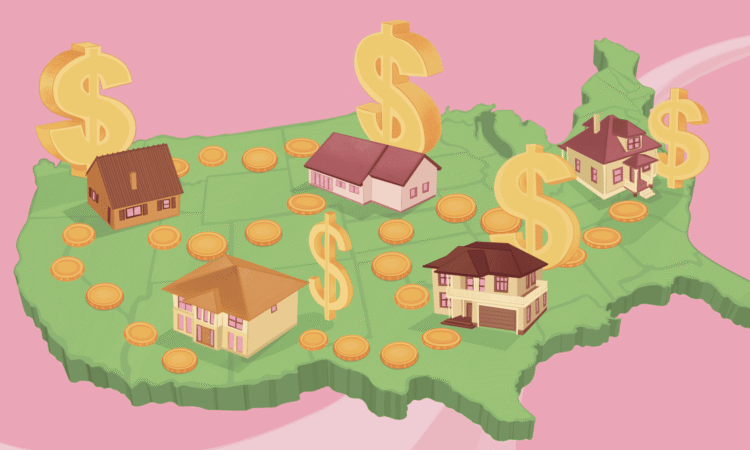
Average Home Prices by State
A report from Zillow reveals the extent to which location can impact the sale price of a home.
As an example, California continues to be one of the most expensive real estate markets nationwide, while prices in some southern states like Florida and Texas have remained level or even dipped in recent quarters. Some of the fastest-rising prices can be found in midwestern states, including Michigan and Illinois, although the median prices in these locations are often still well below the national median.
Here’s a closer look at the median sale price data across 10 of the most populous states as of Jan. 31, 2026:
Understanding the Costs of Buying a Home
Notably, the nationwide median list price of $392,950 is actually higher than the median sale price of $361,000, based on Zillow’s most recent data. This information may help buyers as they consider an offer on a new home.
Still, the listing price is only one part of what buyers actually pay.
Prospective buyers should remember that closing costs tend to be 1% to 4% of the total purchase price of a home, and a down payment can be a significant expense at 2% to 5% of the purchase price as well.
Fast Fact
According to NAR, the typical down payment for first-time buyers reached 10% in 2025, its highest level in nearly four decades.
Besides the down payment, other closing costs might include:
- Inspection fees: A home inspection evaluates the condition of a property to ensure no major issues or necessary repairs.
- Appraisal fees: An appraiser determines the market value of the home, a process that protects the buyer and lenders by ensuring the house is fairly priced relative to comparable properties.
- Title insurance: Title insurance protects the buyer and the lender against claims or legal fees pertaining to potential disputes over the ownership of the home.
- Attorney fees: Costs to cover professional services including preparation of documents in the buying process.
- Additional title agent fees: Fees to the title agent, who oversees the closing process to ensure the title is properly transferred from seller to buyer.
- Loan origination fees: Lenders charge fees to process mortgage applications, including underwriting, documentation, and handling services.
- Additional pre-paid costs: Homeowners insurance, property taxes, mortgage interest, an initial escrow deposit, and potentially other costs all fall within this category.
- Private mortgage insurance (PMI): If a down payment is less than 20% of the home’s purchase price, the buyer may have to pay mortgage insurance to protect the lender in case of default.
These costs add up, but fortunately, there are also ways to reduce the upfront financial burden to a prospective homebuyer. These include:
- Down payment assistance programs: Often provided by state and local governments, these grants or low-interest loans can help to reduce closing costs considerably.
- Discount points: A one-time fee, payable at closing, can lower the interest rate on a mortgage over the lifetime of the loan.
- Seller concessions: Agreements with the seller in which that party pays a portion of the closing costs, including potentially the down payment, to assist the buyer.
Tip
Getting ready to buy a home for the first time? Check out our step-by-step guide to ensure you’re making smart financial decisions, even in a challenging real estate market.
Factors Influencing Home Sale Prices
Many factors go into determining how much a buyer pays for a home. The following are some—but not necessarily all—of them:
Interest Rates
Mortgage rates have a dramatic impact on the lifetime cost of a home, and rates are dependent both upon national metrics and on the type of home loan.
| National Averages of Lenders’ Best Mortgage Rates | ||
|---|---|---|
| Loan Type | New Purchase | Refinance |
| 30-Year Fixed | 6.27% | 6.40% |
| FHA 30-Year Fixed | 6.60% | 6.60% |
| 15-Year Fixed | 5.47% | 5.46% |
| Jumbo 30-Year Fixed | 6.34% | 6.40% |
| 5/6 ARM | 6.56% | 6.73% |
Market & Economic Factors
Mortgage rates are influenced by macroeconomic factors like inflation, which the Federal Reserve aims to control via the federal funds rate. The rate does not have a direct impact on mortgage rates, but the two are closely tied because lenders usually require higher returns to offset the lower purchasing power of money in a higher-rate environment.
Broad economic factors like the job market and inflation can affect home prices—when inflation is high, the cost of materials and labor required to build or update a home increases, as does the cost of land itself. Even for preexisting houses, this can push prices upwards.
In strong job markets and low unemployment periods, homebuyers may have higher incomes, boosting demand for homes and also sending prices skyward. On the other hand, during an economic downturn, demand and prices may be lower.
Credit Profile
Your credit profile helps determine the interest rate you qualify for. The healthier your credit (and the higher your credit score), the lower the rate you may be able to get and the lower the total cost of the loan.
Shelby McDaniels, National Director of Business Development for Home Lending at Chase Bank, says that “when it comes to homeownership, your credit score, along with your debt-to-income ratio, is a major factor in determining what your loan terms will be. That is, whether you’ll be approved for a mortgage, and if so, at what rate.”
Location
State and local taxes will affect closing costs and may vary widely depending upon jurisdiction. Look at property or transfer taxes for your area to get a better sense of how this might impact your purchase of a home.
Locations with a higher overall cost of living may also see increased title insurance, appraisal fees, attorney fees, and other costs related to homebuying. This can also reflect historical housing price differences and other economic trends particular to your location.
Home Type and Size
One of the biggest determinants of the cost of a home is its type and size. Larger homes may be pricier than smaller ones, for instance, and single-family homes tend to be more costly than townhouses, condominiums, or multi-family properties.
On the other hand, larger multi-family properties can see unique costs associated with more extensive inspections, appraisals, or down payment requirements, while condos with lower individual unit prices can still have higher closing costs as a result of prepaid association or condo questionnaire fees.
Additional Costs to Consider
Even after closing, there are other ongoing expenses associated with homeownership that first-time buyers may not be aware of, including:
- Monthly mortgage payments: These cover both principal and interest on the loan and are paid monthly throughout the term of the loan.
- Property taxes: Often paid monthly into an escrow account, these taxes are ultimately paid to the local government annually.
- Homeowners Association (HOA) fees: Properties within a community utilizing shared amenities often face HOA fees that can total hundreds of dollars or more per month.
- Homeowners insurance: Typically paid annually, this insurance protects your property against certain types of damage and loss.
- Utilities: Monthly utility costs may include electricity, water, gas, internet, and more.
- Maintenance and repairs: The cost of maintaining and repairing your home may vary significantly depending on the home and how well it has been cared for over the years.
While not ongoing expenses in the same way, additional costs around the time of purchase may also include furniture, decorations, renovations, or other home improvement projects the buyer may choose to take on before occupying. There is also the cost of moving into the home.
Cost of Homes in the U.S.: What’s Next?
With the Federal Reserve lowering interest rates multiple times in 2025, mortgage rates fell below highs seen years ago—although they remain elevated compared to the much lower rates buyers experienced during the COVID-19 pandemic.
Alana Lindsay of Coldwell Banker Warburg suggests that “home prices really need to be looked at on a hyperlocal level to get a true feel of where the trend lines are for homes in that area.” Lindsay added, “In general, we do not have enough homes being built to keep up with the demand, and that has been an ongoing trend since the 2008 recession.”
Important
While there are many factors that play into home prices, ongoing supply and demand issues have and will likely continue to keep prices high.
Frequently Asked Questions (FAQs)
What is better, homeownership or renting?
Whether homeownership is better than renting depends on your financial goals and long-term plans. Owning builds equity and provides stability, while renting offers flexibility without the burden of spending money to maintain a home.
Can I negotiate closing costs?
Yes, you can negotiate closing costs for a home. Many fees, such as lender fees, title insurance, and even real estate agent commissions, can be negotiated to reduce overall expenses.
Who pays for the closing costs, the seller or the buyer?
Both the buyer and seller can pay closing costs, but typically, buyers cover most fees, including loan-related costs, while sellers often pay agent commissions and transfer taxes. This can vary by negotiation.
The Bottom Line
The cost of buying a home in the U.S. is dependent upon a host of factors, including the property’s size and type, location, local and state taxes, interest rates, the buyer’s credit, and much more. Homebuyers should keep in mind that, while these costs can be high, they are not the only ones to remember: owning a home also means a number of one-time costs at or before the time of occupying the property, as well as ongoing expenses, including a range of taxes and fees. Understanding all of the potential costs can help buyers to plan for what they can afford and, potentially, to save money at the same time.