Nightmare condo board’s sweeping control has blocked a NYC HMart from ever opening: lawsuit

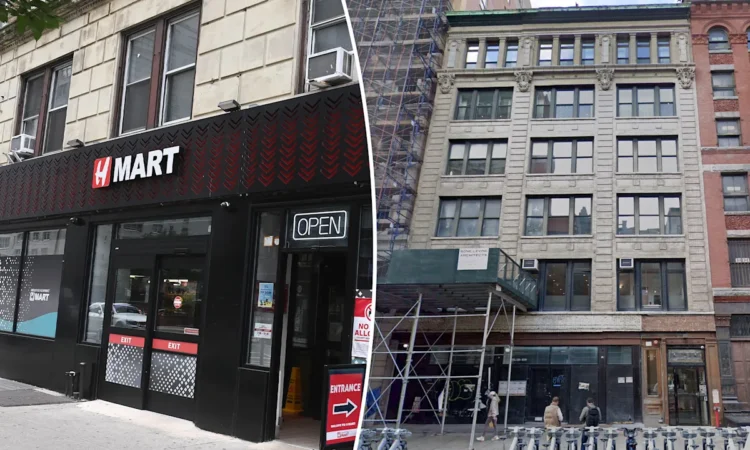
For years, the popular Korean grocery chain HMart has been expected to open at the base of the 111 Hudson St. condominium in Tribeca.
Instead, the storefront remains dark — and, as HMart alleges in court documents, a condo board-related nightmare is standing in the way of it actually opening for business.
After selling the retail space to HMart’s development entity in 2022 for roughly $8 million, the condo board allegedly moved to rewrite the building’s rules in a way that gave residents sweeping control over how the store could operate. Court filings show the shift ultimately derailed HMart’s planned outpost — and has since led to two lawsuits.
The saga began in June 2025, when HMart and the affiliated development entity, HK Property Development LLC, sued the 111 Hudson Street Condominium, its board of managers and several individual unit owners, alleging that the post-approval amendment interfered with their ability to operate a lawful retail business.
In the lawsuits, HMart claims it “never would have purchased [the storefront] under this condition.”

HMart’s long-anticipated Tribeca outpost at 111 Hudson St. has quietly collapsed into a pair of lawsuits after the building’s condo owners voted to dramatically rewrite the rules governing the ground-floor retail space mid-deal, according to court filings viewed by The Post. Google Maps
Court exhibits allegedly show that by the fall of 2022, HMart and its development partners were circulating preliminary fixture and layout plans for the location, including shelving, refrigeration and internal design — a sign, the company argues, that the project was actively underway.
At roughly the same time, court records allege that residents were discussing repairs to the building’s basement and subcellar — an area critical to grocery operations.
It was all set to be housed in the six-floor condominium, which houses just 9 apartments. The last time a unit sold there was back in 2021, when a five-bedroom spread traded hands for $6.5 million.
But then, the documents allegedly show, there were unwelcome surprises.

The Korean grocery chain says it had already begun planning and investing in the store when the board allegedly approved a sweeping amendment that imposed strict operational limits, costly inspection requirements and board approval over nearly every aspect of the business. Getty Images
“HMart had learned that extensive repairs are required to the sub-cellar due to water damage to the structure components of the sub-cellar and also cellar,” the grocer claimed in the June 2025 complaint.
“These store fixture plans illustrated HMart’s intent to construct the HMart grocery store in [the retail space] in a particular manner and to address any problems that HMart had discovered after its purchase of [the retail space],” the filing states.
Days later, HMart alleges the board then voted to adopt a sweeping amendment to the condo’s governing documents. HMart argues this created restrictions that handed residents effective control over day-to-day grocery operations, and were imposed after the retailer had already committed time and money to the site.

The amendment allegedly included requirements for everything from hours and ventilation systems to employee behavior and future transfers. Helayne Seidman
The First Amendment to the condominium declaration, approved in December 2022, did not ban a grocery store outright. Instead, the filing says, it subjected the ground-floor commercial unit — effectively HMart — to a dense layer of oversight.
The rules allegedly capped operating hours to “no earlier than 8 am and no later than 10:30 pm,” restricted signage and sidewalk use and barred employees from entering common areas without permission — all while also mandating high-end ventilation, grease and garbage systems subject to regular third-party inspections at the store’s expense.
Under the amendment, the condo board also allegedly required the store to submit detailed construction plans, budgets, contractor lists and equipment specifications for written approval before applying for permits, and to pay for any experts retained by the board to review the work.
Violations would trigger a short cure period followed by $1,000 daily fines, with the board reserving the right to further limit operations. The amendment also restricted the commercial owner’s ability to sell, lease or assign the unit without board approval.

HMart is now suing both the condominium and the building’s attorney, alleging the post-approval restrictions effectively killed the project. Google Maps
The amendment, according to the court documents, also restricted the unit itself, stating that the commercial owner “shall not sell, lease or assign [the] unit without Board approval.”
While the board maintains that the amendment was valid and within its powers, the filings do not detail specifically what prompted these specific restrictions.
The defendants, in a formal answer filed in December, denied the allegations, arguing that the amendment was properly adopted and fully within the board’s authority under the condo’s bylaws.
HMart and the affiliated development entity then escalated the dispute with a second lawsuit in December against the building’s attorney, alleging that legal representations surrounding approvals and conditions were misleading and contributed to the collapse of the project.
“The Defendants caused harm to Plaintiffs otherwise by acting fraudulently, deceitfully, and in material breach of their duties of good faith and fair dealing in their role as counsel to the 111 Hudson Street Condominium and the 111 Hudson Street Condominium Board of Managers,” the second lawsuit states.

The cases remain active. MKPhoto – stock.adobe.com
The delay has also had the community talking and wondering what’s going on. HMart has four locations in Manhattan, with this being what would be the southernmost location in the borough.
Hyperlocal outlet Tribeca Citizen has chronicled the confusion surrounding the stalled store, noting that even years after the initial announcement, residents remain confused.
“What’s happening at the retail level of 111 Hudson Street, now many years in construction?” One anonymous neighborhood local asked.
“Any update? Another year has gone by…” another wrote.
Both lawsuits remain active, and the retail space at 111 Hudson Street remains unoccupied.
Lawyers for both the plaintiffs and defendants did not return The Post request’s for comment.
Additional reporting by Joyce Cohen