There are different terms that come up frequently in the real estate industry, and you perhaps have spotted some of them in home listings, like “bungalow” and “split-level home.” While you may be familiar with some of this terminology, have you ever wondered what a home a townhouse?
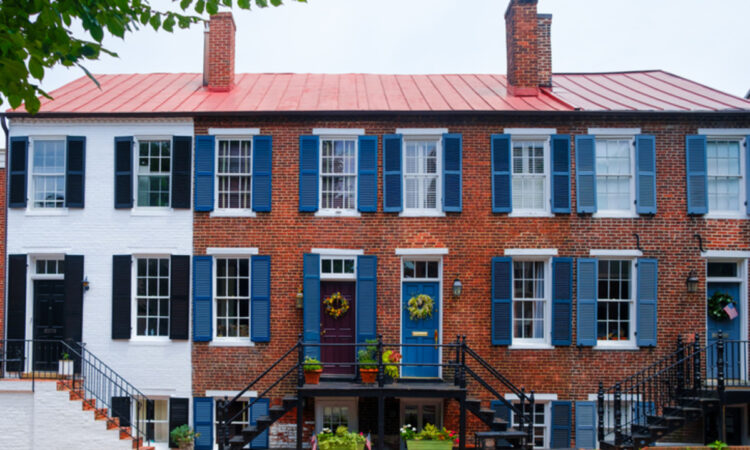
In general, the definition of a townhouse is a multi-story residence that shares one or more walls with neighboring houses. But again, what does that mean exactly? And is a townhouse a wise choice for your next home?
We asked real estate experts to share facts and helpful information so you can learn all about townhouses.
What Is a Townhouse?
Since townhouses share one or more of their walls with other homes, Jacquelynn Rossiter, Principal of The Zolan Rossiter Team @ Compass and a Licensed Associate Real Estate Broker, explains that they are designed to maximize space on narrow lots.
“One of the key features of a townhouse is that you own both the structure and the land it sits on, similar to a single-family home but different from a condo,” Rossiter says. “A typical townhouse is about 18 feet wide by 40 feet deep, but you will see plenty that are both wider and deeper—and the wider the home, the more desirable it is. These homes usually range from two to five stories with private outdoor spaces, such as small yards or rooftop decks.”
She adds that the ground level is typically used for entry, while the main floor, also known as the parlor, is used for living, dining and entertaining, but it can also be used as an entry. The upper floors are typically where you will find the bedrooms.
Jay Kallos, Senior VP of Architecture at Ashton Woods, which specializes in new construction homes, says that townhouses can also be known as townhomes, rowhouses, brownstones, and in England, they are referred to as terraced houses. “A duplex is, in reality, a townhome, with only two houses that are connected to each other,” he says.
History of Townhouses

Getty Images/Alexander Spatari
(Getty Images/Alexander Spatari)
Rossiter says that townhouses as we know them today originated in cities like London and Paris all the way back to the 17th century, “but really have been around as long as there have been towns to include them,” she says. And before that, Mesa Verde, which was built in the 12th century in Colorado, “probably has the earliest row houses built in America.”
Later, Rossiter says that conventional rowhomes popped up in the 18th century in places like Boston, New York and Philadelphia, “and to this day, are located in some of the most treasured neighborhoods in America, like in Boston’s Beacon Hill,” she says.
Over time, townhouses became necessary for city living where space was limited, and allowed homeowners to enjoy nearby urban amenities while owning a home of their own.
Kallos says that today, in particular, New York City townhouses are highly coveted for their historic charm and unique character. “They often feature a graceful blend of classic architecture with modern amenities, such as open-plan kitchens, skylights and walk-in closets,” he says.
Related: What Is It That Actually Makes a House a ‘Bungalow’? A Real Estate Expert Explains
What Is the Difference Between a Condo and a Townhouse?
“The big difference between a townhouse and a condominium is that condos are often all on one level and townhouses have multiple floors connected by flights of stairs,” Kallos says.
Rossiter says that the main difference between a condo and a townhouse really comes down to ownership and lifestyle.
“When you buy a condo, you own your unit, typically contained on a single floor, but not always, and share ownership of the building’s common areas. The condo association handles the building maintenance and amenities. With a townhouse, you typically own both the interior and exterior, giving you more control over your space. For example, you can do your own landscaping and repaint the color of your front door,” she says.
Rossiter goes on to point out, “If you’re looking for convenience without the maintenance, a condo might be perfect. But if you want more space and control, a townhouse is a better choice.”
Different Styles of Townhouses
First of all, Kallos says that sizes can vary quite a bit among townhouses. He says that in some cities, he and his team are seeing townhouses as narrow as 10-feet wide. For a “good width that supports conventional living and sleeping spaces,” there are 14 to 15-foot wide townhouses. He adds that “getting north” of 18 to 25-feet wide “gives you a gracious home.”
Then there’s the differing architecture between townhouses. All of these architectural styles can be witnessed among townhouses and brownstones in New York City, and can be used as a reference for other townhouses you may see across the country.
Italianate
Emerging in the mid-19th century, Rossiter says that this tends to be the architecture style of the classic brownstones seen throughout the city, marked by arched windows, ornate detailing and stoops. “Italianates are what most people picture when they think of a New York townhouse,” she says.
Federal Style
First seen in the late 18th century and early 19th century, Federal Style townhouses are “older and a bit rarer,” as Rossiter says. They are particularly known for their simple and elegant brick construction and painted shutters, as Rossiter puts it.
Greek Revival
Popular in the mid-19th century, Rossiter says that these types of townhouses are punctuated by grand, classical columns and heavy cornices, or decorative molding that circles the walls of a room, landing just below the ceiling.
Neo-Georgian
Spanning from the late 19th century into the 1930s, Rossiter shares that these townhouses are famed for their impeccably polished style and red brick facades.
Do Townhouses Have To Be Single-Family Homes?
“Townhouses don’t have to be single-family homes,” Rossiter says. “While a lot of them are designed for one family, you can also find townhouses divided into multiple units—Sex and the City’s Carrie Bradshaw famously lived on the second floor of a townhouse in the West Village.”
Related: Need Help Writing a House Listing? 15 Best Words To Describe a House for Sale
Are Townhouses Easier to Sell or Buy Than Regular Houses?
If you’re wondering about the resale value of a townhouse, Kallos says that it all comes down to “location, location, location,” which is like any home.
“It always rules in making a residence easier to sell or harder to buy,” he says. But he adds that in most instances, a detached single-family home is preferred over a townhouse, “as you have a bigger yard and you do not share a wall with your neighbor.”
But Kallos believes that a townhouse is easier to sell than a condominium, since you don’t have neighbors above and below you.
In New York City, Rossiter has firsthand experience seeing that both historic and modern townhouses are “highly desirable thanks to their location, original details, charm and the amount of living space they offer.” In other words, it’s preferable to live in a townhouse as opposed to an apartment in a packed urban center.
“Selling a townhouse may be easy, but it all depends on the neighborhood and condition of the home,” she notes.
Pros and Cons of Townhouses
Our experts share the top pros and cons of purchasing, and living in, a townhouse.
Pros
-
Value, since townhouses tend to be located in places with higher land costs, and therefore, are closer to areas with amenities.
-
Character and charm, depending on the architectural style you prefer, that you likely won’t discover in a condo building.
-
More space when compared to apartments and condos, and may even include a small yard or outdoor area.
-
Privacy with your own entrance and fewer shared walls than condos.
Cons
-
Climbing flights of stairs
-
High prices, especially when located in desirable neighborhoods
-
Maintenance if the townhouse is not included in a homeowner’s association
-
Space constraints when compared to suburban single-family homes
Sources