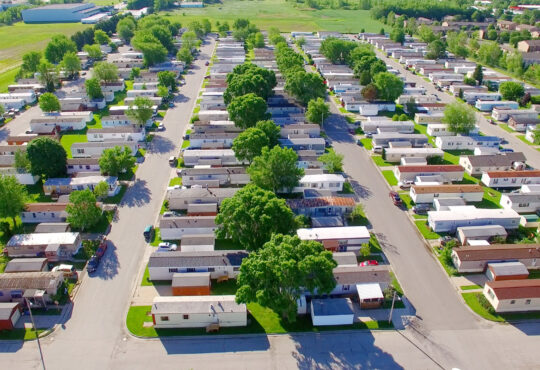
Mobile home parks command a lot of attention in our culture. They’re crooned about in song, used in TV and film as shorthand for people of modest means. But many people don’t know perhaps the single most important thing about them: While residents typically own their own homes, crucially they do not own the land beneath them.
And because so-called mobile homes aren’t easily or cheaply mobile, or mobile at all, that means if a park owner raises rents, or lets the septic system go, or doesn’t otherwise maintain the park, and you want to move, well, good luck.
As Mobile Home University — an online resource for aspiring investors — gushes on its website: “Virtually no tenants can ever afford to move.”
Heh, heh, heh!
“But what happens when a tenant cannot afford to continue to pay their rent?” the site asks. “Then they normally abandon the home, and the park owner ends up with title under abandoned property laws.”
Parks used to be owned mainly by small-time, individual operators, but as they sell to investors, the parks, which are known more formally as manufactured home communities, become valued less as a place to live than for their financial upside.
As John Oliver put it, in a funny-but-not-funny segment in 2019: “Mobile homes may be a terrible investment for people buying them, but they’ve been an incredible investment for Warren Buffett.”
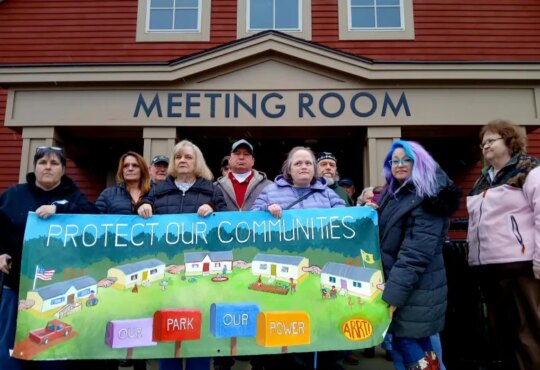
On the Cape, a group of residents is fighting Crown Communities LLC, a Wyoming-based firm that owns and operates 18 mobile home parks in the United States, over who has the right to buy the manufactured home community, The Park at Pocasset.

Pocasset is a 36-acre community in Bourne with about 80 occupied homes, many lovely and inviting, and 22 abandoned homes, some derelict and harboring wild animals, said Andrew Danforth, a consultant with the Cooperative Development Institute, a nonprofit that helps residents own and run their own parks and is working with the group at Pocasset.
There are many ways to lose when you’re elderly, disabled, or of modest means, and the passage of time is one of them.
It’s been more than five years since owner of the Pocasset park, the Charles W. Austin Trust and its trustee, Phil Austin, put the property up for sale for $3.8 million in November 2019, kicking off the legal battle.
The park owner originally signed a purchase-and-sale agreement with Crown. But Massachusetts is one of the few states with a law that gives homeowners in mobile home parks the right of first refusal if their community goes up for sale and they can meet certain requirements. A group of residents was determined to exercise that right, and submitted their own offer.
Crown alleged the residents didn’t meet all the requirements — among them, that 51 percent or more of the residents want to buy the park. The company sued both the homeowners’ association that formed to buy the mobile home park and the owner, claiming it was the rightful buyer.
Over the years, as the case made its way through the courts — with an initial win for Crown, followed by appeals — at least one Pocasset resident has died, and MacDonald, a founding member of the residents association, has moved away.
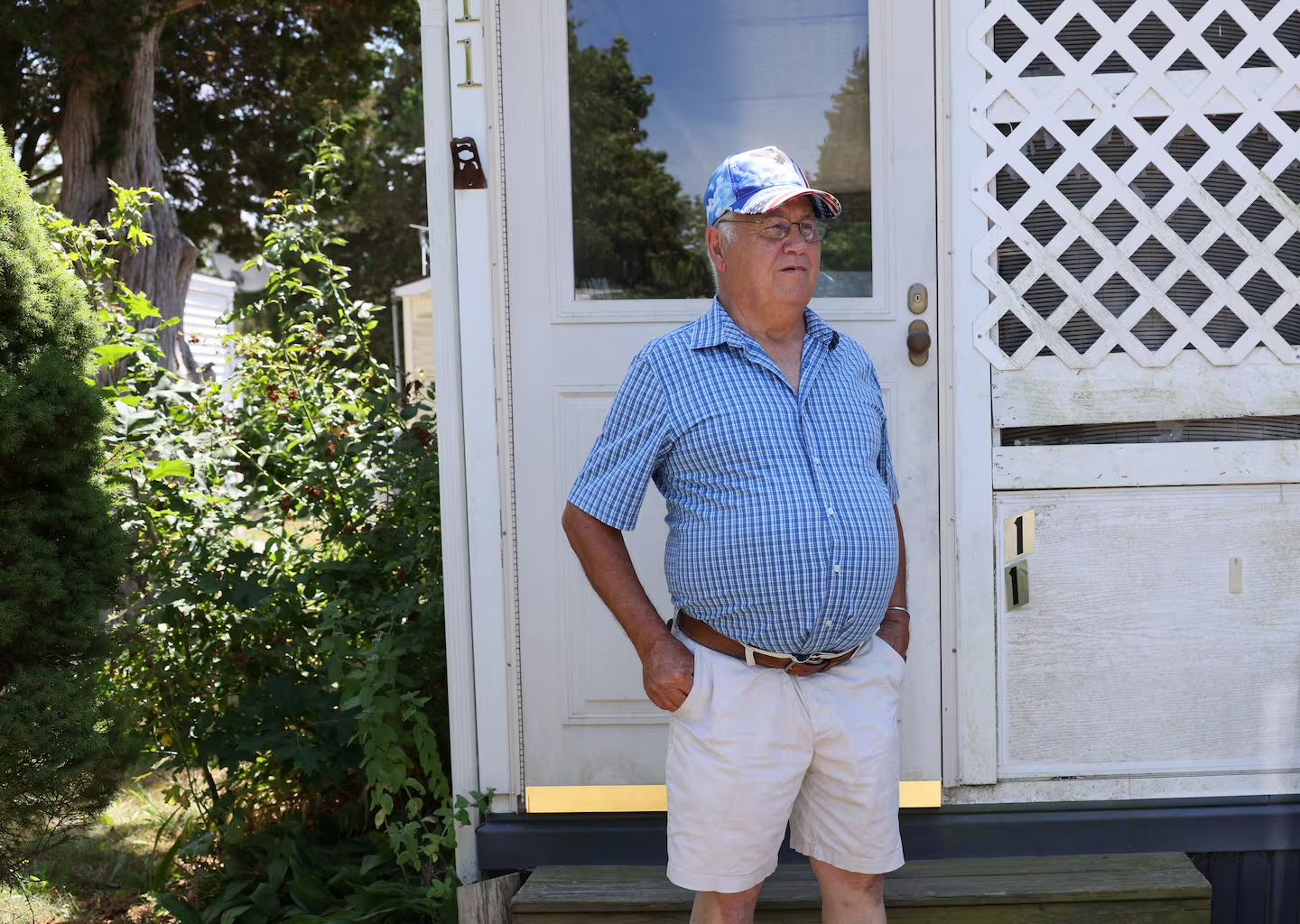
“I lived there for 12 years,” MacDonald said. But he left, frustrated by what he and others say are deteriorating conditions and allegedly retaliatory behavior by the park’s owner, who, from their perspective, is taking out his frustration over the stalled sale on them.

Jessica Rinaldi/Globe Staff
MacDonald secured a spot in subsidized senior housing on the Cape but misses his Pocasset community. “It was my home,” he said wistfully.
Anne-Marie Dinius, an attorney for the Austin Trust, declined to comment.
One of Crown’s founders, Alexander Cabot, is a descendant of Godfrey Lowell Cabot, the famed Boston industrialist. The residents of the park are mainly retirees, blue-collar workers, people with disabilities, the elderly, and families, said Danforth, the consultant with Cooperative Development Institute.
Emphasizing the importance of resident ownership, he pointed to statistics showing that rents in resident-owned communities rise an average of 0.9 percent per year, compared with a 7.1 percent average annual increase in commercially owned communities.
Massachusetts Attorney General Andrea Joy Campbell considers the Pocasset case so important to the state’s Manufactured Housing Act, which offers residents broad protections, that her office filed an amicus brief in support of the residents.

“Given the peril residents face when an owner decides to sell their MHC,” the brief reads, “the Attorney General is particularly concerned that residents have a full and fair opportunity to exercise their [Right of First Refusal] — the exact issue the Court will consider in this case.”
The SJC courtroom was not packed for the hearing, at least not in person. About 100 people who live in other mobile home parks watched remotely or followed with interest, said Nora Gosselin, director of resident acquisitions at the Cooperative Development Institute.
Those watching online included Deborah Winiewicz, a retired 911 dispatcher and police matron, who lives in a resident-owned manufactured home community in Halifax.
“Why is this so important to Crown?” she asked with suspicion.
But Cabot, a founder of Crown, defended his firm. “The value proposition that we can offer to the residents is our long and deep experience acquiring and improving properties,” he wrote in an email.
“Over the years, Crown has turned around over a dozen properties, many of which had suffered decades of neglect under prior ownership,” he wrote.
On Monday, after the hearing, MacDonald and several nonprofit advocates huddled outside the grand courtroom. They’d spent years of their lives fighting to give residents control over their destinies. And now, as Gosselin contemplated the finality of the court’s decision, she drew a breath.
“This is the last stop,” she said.
Beth Teitell can be reached at beth.teitell@globe.com. Follow her @bethteitell.