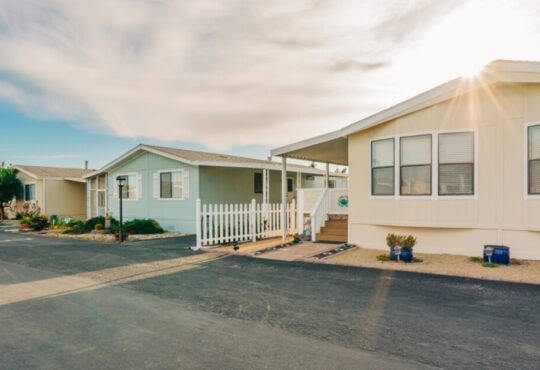
Residents of Asbury Manor East and Asbury Manor West mobile home parks say that problems with road maintenance and communication with management have been near-constant sources of frustration since new park owners took over in 2024, but the largest source of concern has been rent.
Problems with the online payment portal Regal Communities introduced when it took over management meant that Asbury Manor East resident Paula Adams, like other residents, had no way to submit rent payments until the app was fixed.
“By that time we were two months behind on the rent. I know we should’ve held on to that money, but we didn’t, so that put us behind,” Adams recalled recently. “We’ve been paying the rent every month since on time, but they’ve been adding on $150 per month late fees — if you pay past the 5th, $100; past the 10th, another $50 late fee — so I’m over $1,500 on what I owe right now.”
In addition to missed payments and growing late fees, some residents reported making payments that were not credited to their accounts. Others reported that Regal made unauthorized automatic withdrawals from their bank accounts “without prior warning and without the residents’ consent,” according to a lawsuit against the company. The class action suit, filed last May, featured Adams as one of three named class representatives.
A settlement in the suit that provides $1,500 in rent credit, refunds of past increases and late fees, new leases and more to mobile home owners in Meadville and Saegertown has received preliminary approval from Judge Francis Schultz in Crawford County Court of Common Pleas.
Final approval in the case, which pits residents of Asbury Manor East and Asbury Manor West in Meadville and Fountain Homes in Saegertown against the Monsey, New York-based Regal Communities, Regal TIC Management LLC, owner Chaim Schulman and various affiliated companies, is scheduled for March 30.
A win for tenants — for now
“I think this is a good outcome for the residents,” said attorney Kevin Quisenberry of the Pittsburgh-based Community Justice Project, a nonprofit serving low-income clients. None of the residents opted out of being included in the lawsuit’s class action coverage, according to Quisenberry. The Asbury Manor parks consist of 104 total mobile home sites, but only a few dozen are occupied. Nearly all of the 69 sites in the Fountain Homes park are occupied.
The settlement will correct a laundry list of resident claims in the lawsuit.
“We took them very seriously,” Quisenberry said of the claims. “When the new owner came in, they imposed a new lease that had a lot of terms that we thought were illegal. They immediately jacked up the rents — and it was a significant increase — and then they began issuing 10-day notices to quit to evict people that were behind on their rent — and that was unlawful.”
There are significant differences between state laws governing run-of-the-mill landlord-tenant arrangements and those outlining the hybrid relationship between mobile home residents, who typically own their homes, and park owners, who rent the land on which the homes are located to the home owners, Quisenberry said.
Adams’ front door was among those that received a “10-Day Notice to Quit” for alleged nonpayment of rent beginning in October.
“When we began this case, we had several dozen families threatened with immediate eviction,” Quisenberry said.
Lot rents can only be increased at the time of lease renewal, for instance, and homeowners must be notified at least 60 days before any increase and given 30 days to accept the increase or notify the landlord of their intent to vacate within another 30 days. Pennsylvania’s Manufactured Home Community Rights Act also strictly limits the justifications for eviction to nonpayment of rent, two or more violations of community rules within a six-month period, a change in use of the community or termination of the community.
Regal failed to adhere to these requirements in raising lot rent rates for all residents at the three parks in the months after purchasing them, according to the lawsuit.
At the Asbury Manor parks, monthly lot rents were set to increase mid-lease from $546 to $596 and residents were given five days to accept the terms via an online link.
An injunction filed early in the case and later renewed put the brakes on evictions, Quisenberry said.
Under the settlement, Regal must honor the 60-day notification requirement for lot rent increases and any increase in 2026 limited to $75. The settlement does not include any limits for following years.
As a result of the settlement, residents will also receive new leases, a correction of their ledgers and, if necessary, a nine-month repayment plan for any past-due rent remains after late fees have been forgiven and the $1,500 credit processed.
Adams has not yet been notified of an impending increase for 2026, but she expects one soon.
“They did agree to most of our terms. We were trying to get the increase on the lot rent to be a little more affordable, but they didn’t budge on that,” she said. “That part’s a little bit frustrating.”
Protecting tenants from private equity
For Quisenberry, the case is further evidence of the negative impact of the growing presence of private equity investment firms in mobile home parks over the past 10 years or so. What had been a reliably affordable form of housing has become increasingly less so, he said. Mobile home owners are particularly vulnerable since they don’t own the land their houses occupy and in the vast majority of cases — despite the transportability implied by the term “mobile homes” — the homes are either too fragile to move or the cost of doing so would be far out of reach for the owners.
Acquisition of mobile home parks by private equity firms often follows a similar pattern, according to Quisenberry, in which speculators leverage the properties and pull out cash for investment elsewhere.
“Then real investment in the community dwindles and conditions are getting worse and worse and worse while rents are going up and up and up,” he said. “It really is a serious situation.”
Some concerns would be addressed by three proposed bills with bipartisan support that are currently under consideration by the state Senate, Quisenberry noted.
S.B. 745, for instance, would peg rent increases to the consumer price index and limit them in most situations to between 2 percent and 4 percent. It would also prohibit park owners found in violation of property codes from implementing rent increases until at least 180 days after the issues have been resolved.
S.B. 746 would allow resident associations, housing authorities, community development corporations or other nonprofits the chance to match offers to purchase a mobile home before it can be sold to anyone else.
Similar proposals are being considered in the Pennsylvania House.
Sen. Michele Brooks’ office did not respond to a request for comment on the proposed legislation. Rep. Brad Roae also did not respond to a request for comment. Messages left for Regal Communities also went unreturned.
While local elected officials had nothing to say on the issue, Gov. Josh Shapiro has been drawing attention to it. Last week, he visited Douglass Village, a Berks County mobile home park for residents 55 and over, and called on the Legislature to pass the changes that he said would improve conditions for the 56,000 households in mobile home parks across the state.
“Owning your own home is the American dream, but in recent years, we’ve seen greedy out-of-state corporations buy up our communities, increase costs to unaffordable levels and take advantage of Pennsylvanians, especially our seniors,” said Governor Shapiro. “I wanted to visit Douglass Village today to hear from the Pennsylvanians who are pushing back against these out-of-state companies and call for real reforms to protect tens of thousands of homeowners like them. My Housing Action Plan lays out a comprehensive plan to reduce housing costs and protect Pennsylvanians, and I’m calling on the General Assembly to take action by limiting annual lot rent increases for manufactured housing communities.”
Adams hopes the recently formed tenants union for residents of the three parks will be able to lobby local elected officials in favor of the bills. In the meantime, she still has mixed feelings about the settlement as the final approval approaches and she waits to see the various provisions become reality.
“I’m hoping that happens,” she said.
But while the credits to her account will be a relief, she still lives in Asbury Manor, where she said Regal’s maintenance of the park has been unreliable.
Last summer, residents were faced with potholes so severe they wondered whether emergency vehicles could access parts of the parks. After Regal was cited by the city of Meadville, the potholes were repaired, Adams said, but today “it’s three times worse.”
“There was a main water line break that they didn’t fix for 11 days and it made the roads really, really soft,” she continued, “and between the plow trucks and the garbage trucks, our roads are just beyond awful again.”
Even with the rent increase she expects and the poor roads, Adams expects to remain in Asbury Manor. She doesn’t think her trailer would survive any attempt to move it.
“We don’t have much of a choice,” she said. “It’s still cheaper than trying to find an apartment somewhere.”